- Student Success Task Force Video Gallery
- EduSoCal12: Meet/Share/Learn/Play
- CENIC Offers Low-Cost VoIP
- 2012 Online Teaching Conference
- eTranscript California Mini Grants For Colleges
- OTC 2012: Focus On Pre-Conference Workshops
- Nominate Someone: Web, Digital Education Awards
- CENIC Star Performer: Catherine McKenzie
- Online Degree Programs In California
- Spotlight: Amelito Enriquez To Keynote OTC 2012
Latest News
TechEDge eNews Update
Resource Centers Serve California Veterans
Last Updated on Wednesday, 08 June 2011 Written by Gaeir Dietrich & Myra Lerch Tuesday, 07 June 2011

President Barack Obama, center, lays a wreath at the Tomb of the Unknowns at Arlington National Cemetery in honor of America's fallen military service members as part of a national Memorial Day observance May 30, 2011. U.S. Army photo by Eboni L. Myar.
On Memorial Day our nation dedicated a day of remembrance to those that have died in military service to the United States. We honor those that have fallen with the recognition that while all gave some, some gave all. We also honor the fallen by honoring our living veterans as they return home.
With an estimated 2.2 million veterans residing in California, the state leads the nation in the number of veterans according to the California Community Colleges Chancellor's Office Veteran Services website. That number is expected to increase dramatically as more military personnel serving in Iraq and Afghanistan complete their service.
The California Community Colleges system serves veterans of Operation Enduring Freedom (OEF) and Operation Iraqi Freedom (OIF). It is estimated that 16,000 of the 21,000 veterans and their dependents using the GI Bill at California postsecondary institutions are enrolled at a community college. College enrollment of veterans is expected to increase as the state welcomes more veterans home.
Returning veterans arrive on campus as an at-risk population for three primary reasons:
- The academic world poses considerable challenges, as most individuals returning from military service have not attended formal, traditional academic programs for several years (i.e., high school, prior college).
- A significant number of veterans can be described as “nontraditional” learners.
- Many OEF and OIF veterans return with a traumatic brain injury (TBI), post-traumatic stress disorder (PTSD), or other disabilities that pose substantial barriers to academic success.
Typically, these are individuals for whom academic success has not come easily; this is a growing underserved population at the postsecondary level.
Not only are veteran students underserved in terms of targeted support services, a significant number are at risk academically. The current estimate is that approximately 10,000 OEF & OIF veterans have sustained a brain injury. According to the Pentagon, approximately 30 percent of veterans will have PTSD; 40,000 OEF & OIF veterans have already been diagnosed with PTSD.
What are the effects of TBI and PTSD on academic performance? Traumatic brain injury can profoundly affect such cognitive skills as attention, working memory, information processing speed, long-term retention, sequencing and judgment/decision making.
PTSD can create significant difficulties in the following three areas:
- Re-experiencing trauma (e.g., flashbacks, nightmares, intrusive thoughts)
- Arousal (e.g., hypervigilance, irritability, attention deficits)
- Avoidance (e.g., detachment, social withdrawal)
Whether TBI and PTSD occur separately or together, these difficulties can pose considerable barriers to academic success. Veteran students are dedicated, but they are vulnerable.
The beauty of the community college is that it offers a second chance: it represents the open door. Because community college instructors do not carry the pressures to publish or conduct research, their full focus is on teaching. These qualities provide an environment that optimizes chances for academic success, particularly for students who are underserved or at risk; approximately 50% of students in the California Community College system assess into developmental-level classes in English, Reading, or Math.
In addition, the community college offers a broad range of vocational and transfer opportunities.

Plaque at the Legion of Honor, San Francisco. Photo by Sandoval Chagoya.
To meet the needs of these deserving individuals, the High Tech Center Training Unit (HTCTU) at De Anza College—in coordination with the California Community Colleges Chancellor’s Office—proposed establishing a Veterans Resource Center (VRC) on approximately twelve community college campuses, patterned after the VRC at Butte College.
An application is to participate is available to all colleges in the California Community Colleges system. There is no direct cost involved to the individual campus; indirect costs consist of providing physical space, limited equipment and staff time.
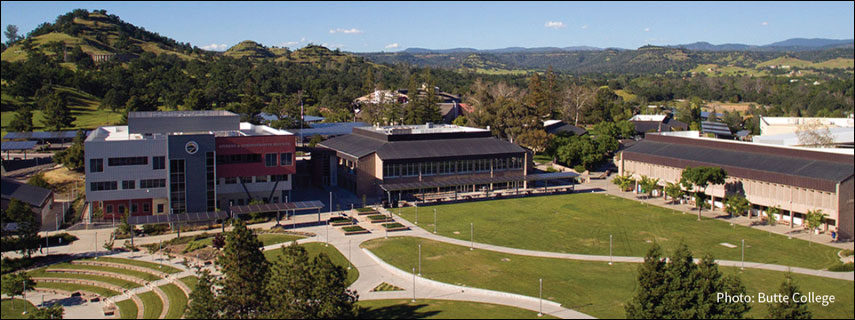
Established in Spring 2008, the Butte College VRC provides a central entry point for veterans and their families as they navigate the civilian and academic worlds. Staffed by veterans, the overall goal is to deliver tangible tools and services to optimize academic success.
This effort involved collaboration between the following offices: Veterans Services, Financial Aid, Disabled Student Programs & Services (DSPS), Counseling and Student Health Center.
At a 2008 Road Home Conference, the VRC was cited as a standout program for meeting the needs of returning veterans. Feedback from veteran students motivates the HTCTU to share this model with other community colleges in California:
The hardest part of transitioning to civilian life from the military has been the lack of camaraderie in the civilian world. The great people I served with have now gone their separate ways. Having the VRC on campus has returned to me access to a circle of friends I feel I can be open with, rely on, and turn to in times of crisis. I can honestly say the VRC is sometimes the only thing that saves me from “burning out” on school and keeps me coming back. (Mike O, USMC, Infantry. Two tours in Iraq.)
Participating colleges and the HTCTU share in providing the central elements of each resource center. The VRC pilot sites represent different geographic regions (Northern, Central, Southern California) with distinct characteristics (rural and urban). These centers serve as demonstration projects, modeling a gateway system that eases the transition and promotes academic success for returning veteran students.
The California Community Colleges campuses that are participating in the Veterans Resource Center provide a dedicated space and resources in support of students who are veterans of the armed services. The pilot sites have been supplied with computers, assistive computer technology, and training and support. The auxiliary sites received software licenses for assistive computer technology, support and training.
Pilot Sites:
- Butte College
- Chaffey College
- City College of San Francisco
- Cuesta College
- El Camino College
- Foothill College
- Fullerton College
- Grossmount College
- Merced College
- Mt San Antonio College
- Pasadena City College
- Riverside City College
- Sacramento City College
- San Joaquin Delta College
- Santa Monica College
Auxiliary Sites:
- College of Alameda
- College of San Mateo
- Cypress College
- De Anza College
- Golden West College
- Los Angeles Trade-Technical College
- Las Positas College
- Reedley College
- Sierra College
What are the fundamental components of a Veterans Resource Center? Although this is vital, a VRC provides services beyond a veterans lounge or clubhouse. The three primary components are:
- Academics
- Camaraderie
- Wellness
Specific services include:
- Access to computers and assistance in the use of assistive technologies, including specialized software for nontraditional learners
- Academic counseling
- Peer support, mentoring
- Financial aid information & application assistance
- Referral to on- and off-campus resources (e.g., DSPS, local VA center)
Academics: The VRC offers a range of tools and strategies that provide scaffolding to optimize academic success. Veteran students may take the Learning Styles Profile, a brief questionnaire that generates an individual’s learning profile. The results equip students with insights about their strongest two learning modes and drive referral to specific tools and strategies.
Two academic support tools in particular are available:
- To aid retention for the significant reading required at the postsecondary level, the Kurzweil 3000 allows the user to scan text and have it read aloud. This provides dual representation in the brain, boosting retention. In general, if students listen to lecture, they will retain approximately 20%. If they read a chapter, retention is approximately 30%. If they combine these input modes—hearing and seeing—retention increases to approximately 50%.
- For nontraditional learners, Inspiration is a program that allows the user to organize thinking in graphic format. Once the material is organized, it is converted to outline form, giving the student a tangible framework to, for example, write a paper.
Because the HTCTU has been providing trainings in assistive technologies since 1987, it is positioned to serve as the central facility for ensuring quality, practical, hands-on trainings to project participants. Its accessible website hosts the Learning Styles Profile results as well as providing strategies and resources concerning TBI, PTSD and other disabilities.
Camaraderie: At its core, the VRC project is based on having veterans provide services directly to fellow veterans. As noted by Thomas Church, “Peer counseling programs use the camaraderie and trust that veterans experience with their peers. Peer counseling programs utilize the military traditions of shared values and experiences and provide a bridge that allows veterans access to more traditional DS offices on campus for students.”
The VRC project is also founded on collaboration, drawing on a range of campus resources. Primary among these is a close collaboration between two offices: Veterans Services and DSPS. The HTCTU and on-site DSPS specialist provide training as needed to the VRC staff; these individuals will then work directly with veteran students.
Wellness: In the VRC, services include referral to such on- and off-campus resources as the Student Health Clinic. In addition, VRC staff will provide consultation to college faculty and staff regarding issues specific to returning veterans and their family members.
The Veterans Resource Center project grows from a proven model, one that provides tangible services that form scaffolding for veteran students as they navigate the academic and civilian worlds. This project is great in terms of return, but lean in terms of cost; it can be easily replicated throughout the California Community College system and nationally.<>
Relevant links:
High Tech Center Training Unit
HTCTU Veterans Resource Centers
California Community Colleges Chancellor's Office:
California's Operation Welcome Home
Gaeir Dietrich is the Director of the High Tech Center Training Unit. Myra Lerch is a consultant for the VRC project.
Comments
Skip to Add Comment
typo corrected
— Sandoval Chagoya 2011-06-08 14:00